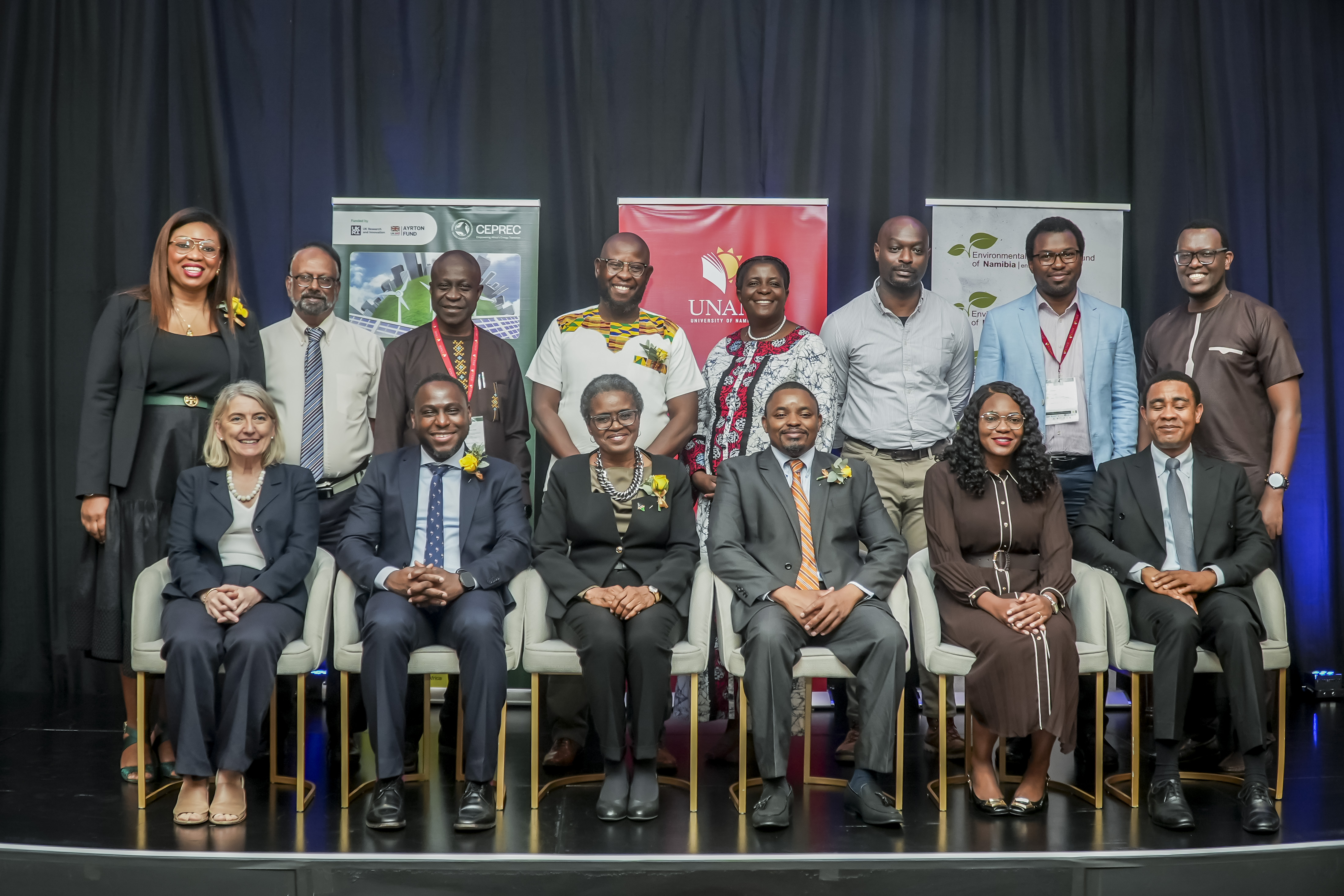
Namibia has reinforced its position at the forefront of Africa’s energy transition following
the successful hosting of the 2026 CEPREC Namibian Summit: High-Level Policy Side
Event, held under the theme “Advancing Circular Energy for Sustainable Development in
Namibia.” The event marked the conclusion of the three-day 2026 International CEPREC
Summit, themed “Closing the Loop: Harnessing Circular Energy and Partnerships to Power
Africa’s Remote Communities.”
Convened by the Circular Economy Powered Renewable Energy Centre (CEPREC) in
partnership with the Environmental Investment Fund of Namibia (EIF) and the University
of Namibia (UNAM), the high-level event brought together senior policymakers, industry
leaders, development partners and academic experts to explore practical pathways for
integrating circular economy principles into renewable energy systems.
The event featured a keynote address by Hon. Indileni Daniel, Minister of Environment,
Forestry and Tourism, who stressed the urgency of advancing sustainable and inclusive
energy systems across Namibia and the African continent. In her address, the Minister
highlighted the dual challenge facing the region, expanding access to reliable and
affordable energy, particularly for rural and underserved communities, while ensuring
that such expansion remains environmentally sustainable, economically viable and
resilient. She noted that across the SADC region, nearly 100 million people still lack access
to electricity, while over 150 million rely on traditional biomass for cooking alongside an
estimated annual energy financing gap of US$83 billion.
Positioning circular energy systems as a practical and necessary solution, the Minister
emphasised that these approaches move beyond the traditional “produce, use, dispose”
model by extending the lifecycle of materials, recovering value from waste and embedding
sustainability across energy systems. She pointed to innovations such as repurposing end-
of-life batteries and strengthening local value chains as key opportunities for the
continent.
Furthermore, the Minister further highlighted that for Namibia, circular energy represents
not only an environmental imperative but a significant economic opportunity. By
embracing such approaches, the country stands to reduce dependency on imports,
stimulate local industries, create jobs, strengthen energy security and position itself as a
regional leader in sustainable innovation. She referenced Namibia’s target of achieving
70 percent renewable energy in the national electricity mix by 2030, supported by policy
reforms such as the Modified Single Buyer model, which is enabling increased
participation from Independent Power Producers. She also noted the country’s ongoing
efforts to advance green industrialisation and confirmed that Namibia is currently
developing a National Circular Economy Policy in collaboration with EIF, aimed at
embedding circularity across key sectors including energy, waste and industrial
development.
Complementing this, the Environmental Investment Fund of Namibia’s Chief Operations
Officer Karl Aribeb, on behalf of the Chief Executive Officer, Mr. Benedict Libanda,
emphasised that the transition to a circular economy powered by renewable energy is no
longer a distant ambition but an immediate and actionable pathway for sustainable
development. He highlighted that when powered by renewable energy, circular
approaches can significantly reduce emissions while unlocking new economic
opportunities. With Namibia’s abundant solar and wind resources, the country is uniquely
positioned to drive industrial growth, stimulate innovation and strengthen local value
chains through circular energy systems. Emphasis was placed on the importance of
coordinated action across government, private sector, financiers and communities to
unlock investment, de-risk innovation and translate policy into implementation.
The role of universities and research institutions was emphasised as critical to bridging
the gap between knowledge and practice. Participants underscored the need for deeper
collaboration between academia, industry, and government to ensure that innovation is
both applicable and scalable within local contexts.
Reflecting on the outcomes, Professor Muyiwa Oyinlola, Director of CEPREC, noted that
the transition to circular energy systems is fundamentally a coordination challenge,
requiring stronger institutional collaboration and more integrated approaches across
sectors. He highlighted Namibia as a compelling example of how locally embedded
partnerships can translate ambition into implementation.
The event also underscored the growing relevance of circular economy approaches,
particularly lifecycle management, reuse, and local value creation, as key enablers of both
environmental sustainability and economic resilience. Participants emphasised that
embedding these principles into policy frameworks, financing models and industrial
strategies will be critical to building inclusive and future-ready energy systems.
A key outcome of the event was the development of a draft communiqué, capturing
priority actions and areas for continued collaboration among stakeholders. This is
expected to inform ongoing policy dialogue and programme development within Namibia
and across the CEPREC partner countries.
Overall, the summit reinforced CEPREC’s role in convening cross-sector dialogue and
advancing research driven, practical solutions to Africa’s energy challenges. It also
highlighted Namibia’s growing leadership in shaping integrated and scalable approaches
to sustainable energy transitions.
– ENDS –
About CEPREC
The Circular Economy Powered Renewable Energy Centre (CEPREC) is a Pan-African
Research Centre of Excellence dedicated to advancing sustainable energy solutions
through circular economy innovations. Funded by the UK Government’s Ayrton Fund,
CEPREC brings together leading institutions from across Africa and the United Kingdom
to drive research, policy engagement and capacity building.
About EIF
The Environmental Investment Fund (EIF) is a fund created by Act 13 of 2001 of the
Parliament of the Republic of Namibia with the overall aim of continuing this great legacy
by supporting individuals, projects and communities that ensure the sustainable use of
natural resources. We create partnerships with NGOs, Government, community-based
organisations and the business community to ensure that our projects
are well–positioned in the socio-economic and environmental tapestry of development
and to guarantee the buy–in of our local and international stakeholders.
Media and Partnership Contact
Abi Okoya
Head, Strategic Partnerships – CEPREC
Email: abi.okoya@dmu.ac.uk
Website: www.ceprec.co
LinkedIn: CEPREC Africa
Nicole van Wyk
Officer: Corporate Communications – EIF
Email: nvanwyk@eif.org.na :
Website: www.eif.org.na


